|
CHARITIES HELPING NICARAGUA CLICK
|
|
|
|
| About Nicaragua - Source: CIA |
|
 |
| Background: |
Settled
as a colony of Spain in the 1520s, Nicaragua gained
its independence in 1821. Violent opposition to
governmental manipulation and corruption spread to all
classes by 1978 and resulted in a short-lived civil
war that brought the Marxist Sandinista guerrillas to
power in 1979. Nicaraguan aid to leftist rebels in El
Salvador caused the US to sponsor anti-Sandinista
contra guerrillas through much of the 1980s. Free
elections in 1990 and again in 1996 saw the
Sandinistas defeated. The country has slowly rebuilt
its economy during the 1990s, but was hard hit by
Hurricane Mitch in 1998. |
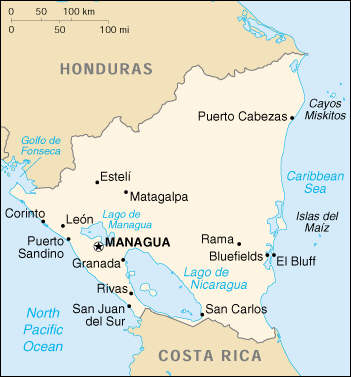
| Location: |
Middle
America, bordering both the Caribbean Sea and the
North Pacific Ocean, between Costa Rica and Honduras |
| Geographic coordinates: |
13
00 N, 85 00 W |
| Map references: |
Central
America and the Caribbean |
| Area: |
total:
129,494 sq km
land: 120,254 sq km
water: 9,240 sq km |
| Area - comparative: |
slightly
smaller than the state of New York |
| Land boundaries: |
total:
1,231 km
border countries: Costa Rica 309 km,
Honduras 922 km |
| Maritime claims: |
continental
shelf: natural prolongation
territorial sea: 200 NM |
| Climate: |
tropical
in lowlands, cooler in highlands |
| Terrain: |
extensive
Atlantic coastal plains rising to central interior
mountains; narrow Pacific coastal plain interrupted by
volcanoes |
| Elevation extremes: |
lowest
point: Pacific Ocean 0 m
highest point: Mogoton 2,438 m |
| Natural resources: |
gold,
silver, copper, tungsten, lead, zinc, timber, fish |
| Land use: |
arable
land: 9%
permanent crops: 1%
permanent pastures: 46%
forests and woodland: 27%
other: 17% (1993 est.) |
| Irrigated land: |
880
sq km (1993 est.) |
| Natural hazards: |
destructive
earthquakes, volcanoes, landslides, and occasionally
severe hurricanes |
| Environment - current issues: |
deforestation;
soil erosion; water pollution; Hurricane Mitch damage
|
| Environment - international
agreements: |
party
to: Biodiversity, Climate Change, Climate
Change-Kyoto Protocol, Desertification, Endangered
Species, Hazardous Wastes, Law of the Sea, Nuclear
Test Ban, Ozone Layer Protection, Ship Pollution,
Wetlands
signed, but not ratified: Environmental
Modification |
| Geography - note: |
largest
country in Central America; contains the largest
freshwater body in Central America, Lago de Nicaragua
|
| Population: |
4,918,393
(July 2001 est.) |
| Age structure: |
0-14
years: 38.98% (male 976,087; female
941,141)
15-64 years: 58.08% (male 1,418,555;
female 1,438,096)
65 years and over: 2.94% (male 62,963;
female 81,551) (2001 est.) |
| Population growth rate: |
2.15%
(2001 est.) |
| Birth rate: |
27.64
births/1,000 population (2001 est.) |
| Death rate: |
4.82
deaths/1,000 population (2001 est.) |
| Net migration rate: |
-1.33
migrant(s)/1,000 population (2001 est.) |
| Sex ratio: |
at
birth: 1.05 male(s)/female
under 15 years: 1.04 male(s)/female
15-64 years: 0.99 male(s)/female
65 years and over: 0.77 male(s)/female
total population: 1 male(s)/female (2001
est.) |
| Infant mortality rate: |
33.66
deaths/1,000 live births (2001 est.) |
| Life expectancy at birth: |
total
population: 69.05 years
male: 67.1 years
female: 71.11 years (2001 est.) |
| Total fertility rate: |
3.18
children born/woman (2001 est.) |
| HIV/AIDS - adult prevalence
rate: |
0.2%
(1999 est.) |
| HIV/AIDS - people living with
HIV/AIDS: |
4,900
(1999 est.) |
| HIV/AIDS - deaths: |
360
(1999 est.) |
| Nationality: |
noun:
Nicaraguan(s)
adjective: Nicaraguan |
| Ethnic groups: |
mestizo
(mixed Amerindian and white) 69%, white 17%, black 9%,
Amerindian 5% |
| Religions: |
Roman
Catholic 85%, Protestant |
| Languages: |
Spanish
(official)
note: English and indigenous languages on
Atlantic coast |
| Literacy: |
definition:
age 15 and over can read and write
total population: 65.7%
male: 64.6%
female: 66.6% (1995 est.) |
| Country name: |
conventional
long form: Republic of Nicaragua
conventional short form: Nicaragua
local long form: Republica de Nicaragua
local short form: Nicaragua |
| Government type: |
republic
|
| Administrative divisions: |
15
departments (departamentos, singular - departamento),
2 autonomous regions* (regiones autonomistas, singular
- region autonomista); Boaco, Carazo, Chinandega,
Chontales, Esteli, Granada, Jinotega, Leon, Madriz,
Managua, Masaya, Matagalpa, Nueva Segovia, Rio San
Juan, Rivas, Atlantico Norte*, Atlantico Sur* |
| Independence: |
15
September 1821 (from Spain) |
| National holiday: |
Independence
Day, 15 September (1821) |
| Constitution: |
9
January 1987, with reforms in 1995 and 2000 |
| Legal system: |
civil
law system; Supreme Court may review administrative
acts |
| Suffrage: |
16
years of age; universal |
| Executive branch: |
chief
of state: President Arnoldo ALEMAN Lacayo
(since 10 January 1997); Vice President Leopoldo
NAVARRO (since 24 October 2000); note - the president
is both chief of state and head of government
head of government: President Arnoldo
ALEMAN Lacayo (since 10 January 1997); Vice President
Leopoldo NAVARRO (since 24 October 2000); note - the
president is both chief of state and head of
government
cabinet: Council of Ministers appointed
by the president
elections: president and vice president
elected on the same ticket by popular vote for a
five-year term; election last held 20 October 1996
(next to be held 4 November 2001); note - in July 1995
the term of the office of the president was amended to
five years
election results: Arnoldo ALEMAN Lacayo
(Liberal Alliance - ruling party - includes PLC, PALI,
PLIUN, and PUCA) 51.03%, Daniel ORTEGA Saavedra (FSLN)
37.75%, Guillermo OSORNO (PCCN) 4.10%, Noel VIDAURRE
(PCN) 2.26%, Benjamin LANZAS (PRONAL) 0.53%, other (18
other candidates) 4.33% |
| Legislative branch: |
unicameral
National Assembly or Asamblea Nacional (93 seats;
members are elected by proportional representation to
serve five-year terms)
elections: last held 20 October 1996
(next to be held 4 November 2001)
election results: percent of vote by
party - Liberal Alliance (ruling party - includes PLC,
PALI, PLIUN, and PUCA) 46.03%, FSLN 36.55%, PCCN
3.73%, PCN 2.12%, MRS 1.33%; seats by party - Liberal
Alliance 42, FSLN 36, PCCN 4, PCN 3, PRONAL 2, MRS 1,
PRN 1, PC 1, PLI 1, AU 1, UNO-96 Alliance 1 |
| Judicial branch: |
Supreme
Court or Corte Suprema (16 judges elected for
seven-year terms by the National Assembly) |
| Political parties and
leaders: |
Conservative
Party of Nicaragua or PCN [Dr. Fernando AGUERO Rocha];
Independent Liberal Party or PLI [Virgilio GODOY];
Liberal Alliance (ruling alliance including Liberal
Constitutional Party or PLC, New Liberal Party or
PALI, Independent Liberal Party for National Unity or
PLIUN, and Central American Unionist Party or PUCA)
[leader NA]; National Conservative Party or PC [Pedro
SOLARZANO, Noel VIDAURRE]; National Project or PRONAL
[Benjamin LANZAS]; Nicaraguan Party of the Christian
Path or PCCN [Guillermo OSORNO, Roberto RODRIGUEZ];
Nicaraguan Resistance Party or PRN [Salvador
TALAVERA]; Sandinista National Liberation Front or
FSLN [Daniel ORTEGA Saavedra]; Sandinista Renovation
Movement or MRS [Sergio RAMIREZ]; Unity Alliance or AU
[Alejandro SERRANO]; Union Nacional Opositora 96 or
UNO-96 [Alfredo CESAR Aguirre] |
| Political pressure groups and
leaders: |
National
Workers Front or FNT is a Sandinista umbrella group of
eight labor unions including - Farm Workers
Association or ATC, Health Workers Federation or
FETASALUD, Heroes and Martyrs Confederation of
Professional Associations or CONAPRO, National
Association of Educators of Nicaragua or ANDEN,
National Union of Employees or UNE, National Union of
Farmers and Ranchers or UNAG, Sandinista Workers
Central or CST, and Union of Journalists of Nicaragua
or UPN; Permanent Congress of Workers or CPT is an
umbrella group of four non-Sandinista labor unions
including - Autonomous Nicaraguan Workers Central or
CTN-A, Confederation of Labor Unification or CUS,
Independent General Confederation of Labor or CGT-I,
and Labor Action and Unity Central or CAUS; Nicaraguan
Workers' Central or CTN is an independent labor union;
Superior Council of Private Enterprise or COSEP is a
confederation of business groups |
| International organization
participation: |
BCIE,
CACM, CCC, ECLAC, FAO, G-77, IADB, IAEA, IBRD, ICAO,
ICFTU, ICRM, IDA, IFAD, IFC, IFRCS, ILO, IMF, IMO,
Intelsat, Interpol, IOC, IOM, ISO (correspondent),
ITU, LAES, LAIA (observer), NAM, OAS, OPANAL, OPCW,
PCA, UN, UNCTAD, UNESCO, UNHCR, UNIDO, UPU, WCL, WHO,
WIPO, WMO, WToO, WTrO |
| Diplomatic representation in
the US: |
chief
of mission: Ambassador Alfonso ORTEGA
Urbina
chancery: 1627 New Hampshire Avenue NW,
Washington, DC 20009
telephone: [1] (202) 939-6570
FAX: [1] (202) 939-6542
consulate(s) general: Houston, Los
Angeles, Miami, New Orleans, New York |
| Diplomatic representation
from the US: |
chief
of mission: Ambassador Oliver P. GARZA
embassy: Apartado Postal 327, Kilometer
4.5 Carretera Sur, Managua
mailing address: APO AA 34021
telephone: [505] (2) 662298, 666010,
666012, 666013, 666015, 666018, 666026, 666027,
666032, 666033
FAX: [505] (2) 669074 |
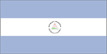
| Flag description: |
three
equal horizontal bands of blue (top), white, and blue
with the national coat of arms centered in the white
band; the coat of arms features a triangle encircled
by the words REPUBLICA DE NICARAGUA on the top and
AMERICA CENTRAL on the bottom; similar to the flag of
El Salvador, which features a round emblem encircled
by the words REPUBLICA DE EL SALVADOR EN LA AMERICA
CENTRAL centered in the white band; also similar to
the flag of Honduras, which has five blue stars
arranged in an X pattern centered in the white band |
| Economy - overview: |
Nicaragua,
one of the hemisphere's poorest countries, faces low
per capita income, flagging socio-economic indicators,
and huge external debt. While the country has made
progress toward macro-economic stabilization over the
past few years, a banking crisis and scandal has
shaken the economy. Managua will continue to be
dependent on international aid and debt relief under
the Heavily Indebted Poor Countries (HIPC) initiative.
Donors have made aid conditional on improving
governability, the openness of government financial
operation, poverty alleviation, and human rights.
Nicaragua met the conditions for additional debt
service relief in December 2000. Growth should remain
moderate to high in 2001. |
| GDP: |
purchasing
power parity - $13.1 billion (2000 est.) |
| GDP - real growth rate: |
5%
(2000 est.) |
| GDP - per capita: |
purchasing
power parity - $2,700 (2000 est.) |
| GDP - composition by sector: |
agriculture:
31.6%
industry: 22.8%
services: 45.6% (1999) |
| Population below poverty
line: |
50%
(2000 est.) |
| Household income or
consumption by percentage share: |
lowest
10%: 1.6%
highest 10%: 39.8% (1993) |
| Inflation rate (consumer
prices): |
11%
(2000 est.) |
| Labor force: |
1.7
million (1999) |
| Labor force - by occupation: |
services
43%, agriculture 42%, industry 15% (1999 est.) |
| Unemployment rate: |
20%
plus considerable underemployment (1999 est.) |
| Budget: |
revenues:
$734 million
expenditures: $836 million, including
capital expenditures of $NA (1999 est.) |
| Industries: |
food
processing, chemicals, machinery and metal products,
textiles, clothing, petroleum refining and
distribution, beverages, footwear, wood |
| Industrial production growth
rate: |
4.4%
(2000 est.) |
| Electricity - production: |
2.349
billion kWh (1999) |
| Electricity - production by
source: |
fossil
fuel: 67.26%
hydro: 17.71%
nuclear: 0%
other: 15.03% (1999) |
| Electricity - consumption: |
2.265
billion kWh (1999) |
| Electricity - exports: |
20
million kWh (1999) |
| Electricity - imports: |
100
million kWh (1999) |
| Agriculture - products: |
coffee,
bananas, sugarcane, cotton, rice, corn, tobacco,
sesame, soya, beans; beef, veal, pork, poultry, dairy
products |
| Exports: |
$631
million (f.o.b., 2000 est.) |
| Exports - commodities: |
coffee,
shrimp and lobster, cotton, tobacco, beef, sugar,
bananas; gold |
| Exports - partners: |
US
37.7%, El Salvador 12.5%, Germany 9.8%, Costa Rica
5.1%, Spain 2.5%, France 2.1% (1999) |
| Imports: |
$1.6
billion (f.o.b., 2000 est.) |
| Imports - commodities: |
machinery
and equipment, raw materials, petroleum products,
consumer goods |
| Imports - partners: |
US
34.5%, Costa Rica 11.4%, Guatemala 7.3%, Panama 6.9%,
Venezuela 5.9%, El Salvador 5.5% (1999) |
| Debt - external: |
$6.4
billion (2000 est.) |
| Economic aid - recipient: |
NA
|
| Currency: |
gold
cordoba (NIO) |
| Exchange rates: |
gold
cordobas per US dollar - 12.96 (November 2000), 12.69
(2000 est.), 11.81 (1999), 10.58 (1998), 9.45 (1997),
8.44 (1996) |
| Fiscal year: |
calendar
year |
| Telephones - main lines in
use: |
140,000
(1996) |
| Telephones - mobile cellular: |
7,911
(1997) |
| Telephone system: |
general
assessment: inadequate system being
upgraded by foreign investment
domestic: low-capacity microwave radio
relay and wire system being expanded; connected to
Central American Microwave System
international: satellite earth stations -
1 Intersputnik (Atlantic Ocean region) and 1 Intelsat
(Atlantic Ocean) |
| Radio broadcast stations: |
AM
63, FM 32, shortwave 1 (1998) |
| Radios: |
1.24
million (1997) |
| Television broadcast
stations: |
3
(plus seven low-power repeaters) (1997) |
| Televisions: |
320,000
(1997) |
| Internet country code: |
.ni
|
| Internet Service Providers
(ISPs): |
3
(2000) |
| Internet users: |
20,000
(2000) |
| Railways: |
total:
6 km
narrow gauge: 6 km 1.067-m gauge (2001) |
| Highways: |
total:
16,382 km
paved: 1,818 km
unpaved: 14,564 km (1998) |
| Waterways: |
2,220
km (including 2 large lakes) |
| Pipelines: |
crude
oil 56 km |
| Ports and harbors: |
Bluefields,
Corinto, El Bluff, Puerto Cabezas, Puerto Sandino,
Rama, San Juan del Sur |
| Merchant marine: |
none
(2000 est.) |
| Airports: |
182
(2000 est.) |
| Airports - with paved
runways: |
total:
11
2,438 to 3,047 m: 2
1,524 to 2,437 m: 3
914 to 1,523 m: 3
under 914 m: 3 (2000 est.) |
| Airports - with unpaved
runways: |
total:
171
1,524 to 2,437 m: 1
914 to 1,523 m: 25
under 914 m: 145 (2000 est.) |
| Military branches: |
Army,
Navy, Air Force |
| Military manpower - military
age: |
18
years of age |
| Military manpower -
availability: |
males
age 15-49: 1,269,322 (2001 est.) |
| Military manpower - fit for
military service: |
males
age 15-49: 779,267 (2001 est.) |
| Military manpower - reaching
military age annually: |
males:
58,232 (2001 est.) |
| Military expenditures -
dollar figure: |
$26
million (FY98) |
| Military expenditures -
percent of GDP: |
1.2%
(FY98) |
| Disputes - international: |
territorial
disputes with Colombia over the Archipelago de San
Andres y Providencia and Quita Sueno Bank; with
respect to the maritime boundary question in the Golfo
de Fonseca, the ICJ referred to the line determined by
the 1900 Honduras-Nicaragua Mixed Boundary Commission
and advised that some tripartite resolution among El
Salvador, Honduras, and Nicaragua likely would be
required; maritime boundary dispute with Honduras in
the Caribbean Sea is before the ICJ; legal dispute
over navigational rights of San Juan River on border
with Costa Rica |
| Illicit drugs: |
transshipment
point for cocaine destined for the US and
transshipment point for arms-for-drugs dealing |
FOR
INFORMATION ABOUT CHARITIES HELPING NICARAGUA CLICK
|